
Mint Industry
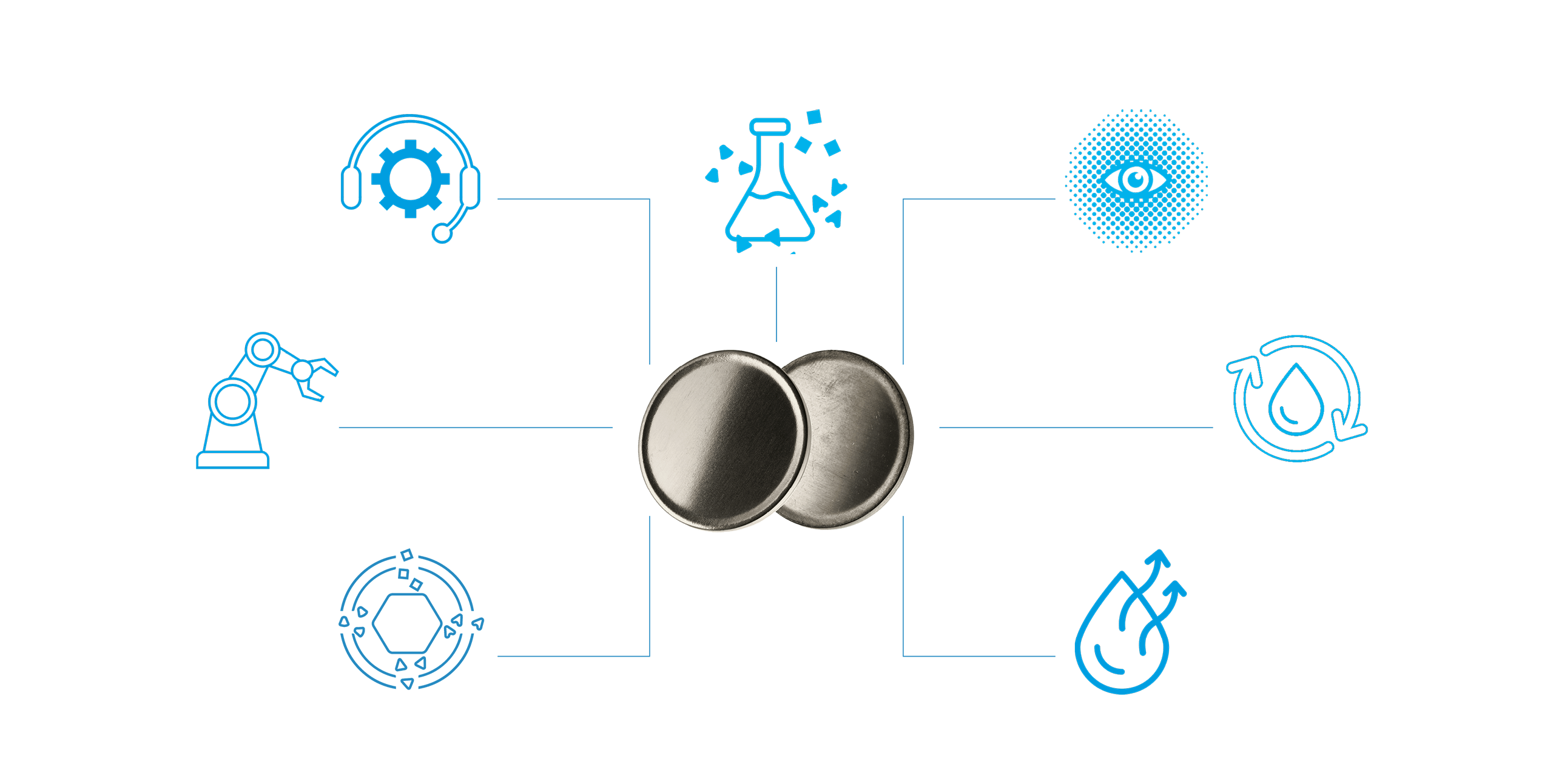
As a specialist in the minting industry, we have been developing targeted solutions for optimizing coin blanks for over 25 years. In addition to precisely coordinated machines, we rely on future-oriented technologies such as process water treatment with vacuum distillation and automated inspection systems with 2D and 3D image processing. In this way, we guarantee consistent quality in the embossing and sustainable processes in production.
Process media
Our aim is to provide coin blanks with a spotless and glossy surface to ensure the highest quality during the minting process. We offer a comprehensive selection of chemicals and media for this purpose:
- Compounds for cleaning, pickling and polishing
- CHD: High-performance ceramic media
- SHD: Stainless steel polishing media
Blank processing
From small to large volumes – we bring movement to your processes and offer various surface technologies, such as rotation, centrifugal force or vibration processing.
- RTS ME: Drum finisher
- Z4/Z11/Z33BFN: Centrifugal system for small and medium-sized applications
- Z33/Z44 BFC: Centrifugal system
for large-volume applications - BFTF10: Continuous vibration system
Die processing
As important as the preparation of the blanks is for the quality of the finished coins or medals, the production of the dies is just as crucial. We support you in the preparation of die blanks for the hobbing or laser process and in polishing the final relief on the die prior to the application of coating technologies.
- DCF33: Drag finishing system for polishing punches and punch cones
Drying systems
Due to limitations in terms of energy consumption and noise levels, the hot air dryer is no longer considered state of the art. It has been replaced by linear textile drying technology, which enables the drying of coin blanks at a rate of up to 1,500 kg/h in numismatic quality.
- TT: Manual drying table with microfiber textile technology
- SFT: Linear textile dryer
- VAT: Hot air dryer for coating processes
Process water treatment
Water has always been and will always be a valuable resource. Our recycling technology based on vacuum distillation enables you to reuse 95% of the waste water produced in the next finishing process.
- VD: Vacuum evaporator for treating the process water
Automation
On request, we can expand your finishing process with material handling systems:
- Stacking device for stacking blanks for automatic feeding to the press
- CPM: Individual processing of precious metal bars
- Continuous refining process for large
silver blanks and bars with fully automated handling
Inspection technology
We rely on our optical inspection systems for the quality assurance of circulation coins, bullion and collector coins:
- SIT200: Fully automatic inspection system for coins and coin blanks
- SIT300: Fully automatic inspection system for coin blanks
- SITdesk: Inspection system for manual applications
- SITpure: Customized integrated inspection system
We have been an active member of the IMD technical community since 2009 and are involved in specialist committees and working groups in the international mint industry. With the annual organisation of the Technical Forum since 2004 and our participation in the International Mint Industry Association, we set standards in technical exchange and in the further development of the industry.

Downloads
Your Sales Contacts


FAQ
Why is the surface treatment of coin blanks so important?
The surface treatment of coin blanks is a crucial step in preparing them for the minting process. The aim is to create a clean, shiny and uniform metal surface that meets the highest quality standards.
Polishing removes oxides, residues and other impurities. At the same time, the use of suitable grinding and polishing media creates a fine surface structure that improves the flow of material during minting. This contributes significantly to the minting tool being able to act precisely and evenly on the blank – a decisive factor for the detail accuracy and durability of the minted coins.
Finishing should ideally be carried out immediately before the embossing process in order to ensure optimum embossing quality.
What processing methods are used in the mint industry?
In the mint industry, specially formulated process media are used to optimally prepare coin blanks for the minting process. Both chemical and mechanical components play a central role in this.
The compounds used for polishing can be divided into two main groups:
- Acid-based pickling compounds remove oxides and impurities that arise during manufacturing, storage, or transport.
- Alkaline-based polishing compounds ensure a smooth, shiny surface with water-repellent properties. This effect supports effective drying results and improves the short- and medium-term tarnish resistance of the blanks.
High-quality polishing media are used for mechanical processing:
- Stainless steel media – mostly in the form of balls or satellites – are considered the gold standard. They are characterized by high corrosion resistance and a scratch-free surface to avoid damaging the sensitive blanks.
- Ceramic media offer a powerful alternative, especially for processing precious metals. They are also available in ball or satellite form and impress with excellent surface properties and chemical resistance. In combination with stainless steel media, they enable particularly fine finishing results.
Which types of machines are most commonly used for processing coin blanks?
Centrifugal disc finishing machines are predominantly used for processing coin blanks. These machines harness the high energy generated by centrifugal force to enable particularly efficient and uniform surface treatment. A further advantage lies in the high degree of automation possible with this process, making it ideal for industrial applications with large quantities. In specific cases, continuous flow systems or rotating drums are also used. However, these processes are more to be regarded as niche solutions.
Why is a distinction made between circulation coins and collector coins when processing coin blanks?
The processing of coin blanks differs significantly depending on their intended use.
Circulation coins are produced in large quantities and are intended for daily use. Therefore, the focus is on a highly efficient, industrialized process that ensures good quality while maintaining high output – with production capacities of up to 1,500 kg per hour per system.
In contrast, the production of collector coins and medals is more akin to an artistic process. Here, design, precision of detail, and a perfect visual appearance are paramount. Production volumes are significantly lower, but quality requirements are considerably higher.
To meet these diverse requirements, we have developed specialized product lines that are optimally tailored to the specific needs of the mint industry – from mass production to high-quality individual customization.
How is process water treated in the mint industry?
Water plays a central role in the processing of coin blanks. In addition to the machines, chemicals, and polishing media, the quality and reusability of the process water also have a decisive influence on the final result. We therefore recommend the use of vacuum distillation systems to efficiently treat the process water produced during pickling and polishing. This process allows up to 95% of the process water to be recycled and directly returned to the processing cycle. This not only ensures sustainable use of resources, but also consistently high water quality in the production process.
Other, older technologies do allow treatment for discharge into the public sewer system, but consume significantly more water and are less efficient. Vacuum distillation is therefore the preferred solution for environmentally friendly and economical water treatment in the minting industry.